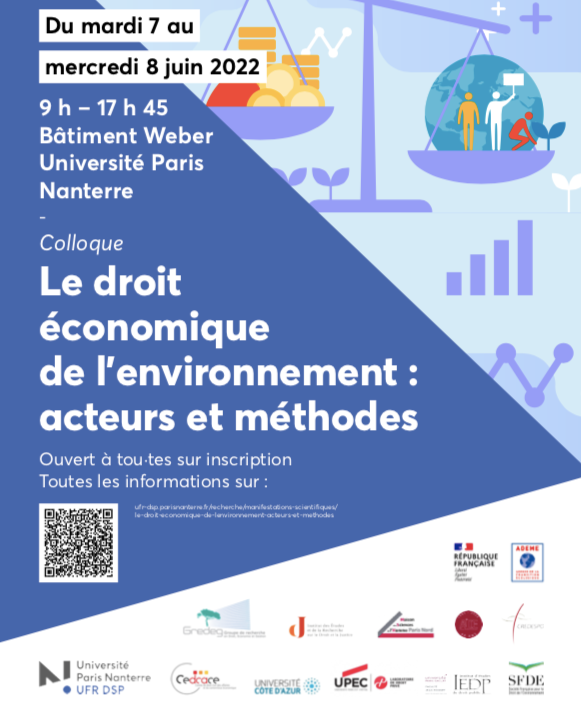
Le deuxième colloque du projet de recherche aura lieu les 7 et 8 juin sur le campus de l’Université de Nanterre.
Contact: colloque.transition@protonmail.com
Intervenants

Jennifer Bardy est maître de conférences en droit privé à l’Université Côte d’Azur et membre du GREDEG. Ses travaux de recherche visent à interroger notre représentation comptable du monde et réfléchir aux moyens juridiques d’intégration des défis environnementaux et sociaux de notre siècle. A cette fin, elle s’appuie sur les travaux conduits en sciences de gestion dans le champ des comptabilités environnementales et entend souligner le rôle des juristes pour permettre à l’entreprise de mieux « rendre compte » des impacts de son activité sur l’environnement.

Raphaël Brett est maître de conférence en droit public à l’Université Paris-Saclay (faculté Jean Monnet), membre de l’IEDP et président de la section Île-de-France de la SFDE. Dans le prolongement de sa thèse intitulée La participation du public à l’élaboration des normes environnementales, ses travaux de recherche portent principalement sur l’influence exercée par les questions écologiques sur les droits constitutionnel et administratif. Il s’intéresse également à l’évolution de la protection juridique de la biodiversité, notamment des forêts.

Walid Chaiehloudj est agrégé des facultés de droit, Professeur de droit privé à l’Université de Perpignan. Il est membre du Centre de droit économique et du développement Yves Serra (CDEDYS) et chercheur associé au GREDEG. Ses travaux de recherche portent sur le droit économique lato sensu. Il a publié de nombreux articles en droit de la concurrence et a participé à un grand nombre de projets collectifs. Récemment, ses réflexions se sont cristallisées autour de la contribution du droit de la concurrence à la protection de l’environnement (“Le droit de la concurrence est-il un frein à la protection de l’environnement?”, Contrats, conc. consom. 2022, n° 4, étude 6) ; de la question de l’articulation du droit de la concurrence avec la régulation du numérique (“Le droit de la régulation numérique marginalisera-t-il le droit de la concurrence ? Réflexions à la lumière de l’affaire Epic Games c/ Apple”, Concurrences n° 3-2021) ; et du droit des plateformes numériques et du cerveau (“Plateformes numériques et cerveau: entre puissance des plateformes et (im)puissance du droit” in Cerveau(x) et droit (dir. J. Mestre et S. Lacroix-De Sousa, LGDJ, à paraître). Il est également membre du Collège de l’Autorité de la concurrence de la Nouvelle-Calédonie.

Marie-Alice Chardeaux est maître de conférences à l’Université de Paris-Est Créteil (UPEC). Elle est membre du Laboratoire de droit privé (LDP). Ses travaux sont consacrés aux communs et à leurs déclinaisons, telles que les choses communes, les biens communs ou les patrimoines communs. Ses travaux embrassent des objets d’une grande diversité : l’eau, l’air, la mer, les grands fonds marins, en passant par les idées, les inventions dans le domaine public, les creative commons ou les grottes ornées. Ses recherches se situent ainsi au carrefour du droit civil, du droit de la propriété intellectuelle et du droit de l’environnement. Au cœur de ses travaux, une réflexion sur ce qui est ou doit être commun. Dans le prolongement de sa thèse sur Les Choses communes, elle suggère de relire, voire de reconstruire certaines catégories juridiques porteuses d’un intérêt collectif, afin de les faire tendre vers plus de commun.

Florian Couveinhes Matsumoto est maître de conférences et directeur des études du Parcours Droit de l’École normale supérieure (Paris, Ulm). Ses travaux portent à la fois sur l’histoire et la philosophie du Droit, et sur le Droit international. En Droit international, ses travaux portent principalement sur trois thèmes:
1) le rapport entretenu par la Chine et par le Japon au Droit international d’hier et d’aujourd’hui
2) la démocratisation des procédures nationales de négociation, conclusion, ratification et dénonciation des traités
3) le renouvellement de la conception dominante du Droit international économique, des accords, corpus normatifs et tribunaux en relevant pour intégrer pleinement les implications des Droits internationaux de la sécurité, du travail, de la santé, de l’écologie, etc.

Arnaud de Nanteuil est Professeur à l’Université Paris Est Créteil où il enseigne essentiellement le droit international public, le droit international économique et le droit international des investissements. Il est également directeur du LLM « Contentieux international des affaires approfondi » dans cette même université. Il est l’auteur du seul manuel français consacré au droit international des investissements ainsi que de très nombreuses publications dans ce domaine. Il exerce des missions de conseil en arbitrage international et siège également comme arbitre.

Alessandra Donati est référendaire à la Cour de justice de l’Union européenne. Elle est spécialisée en droit européen de l’environnement et de la santé publique avec une attention particulière à la question de la régulation des risques. Avant de rejoindre la Cour, Alessandra a été chercheuse postdoctorale à l’Université du Luxembourg et Senior Research Fellow à l’Institut Max Planck de Luxembourg. Précédemment, elle a travaillé comme avocate dans deux cabinets en Italie (Chiomenti) et en France (Castaldi Partners).
Alessandra a fait ses études à l’Université Bocconi de Milan (licence et master en droit), à l’Université Politecnica delle Marche (licence et master en management) et à l’Université Paris 1 Panthéon Sorbonne (LLM en droit européen). Elle est docteur en droit de l’Université Paris 1 Panthéon Sorbonne. Sa thèse de doctorat, qui examine le principe de précaution en droit de l’UE, a été publiée en 2021 par Bruylant.
Alessandra a été Visiting Fellow à l’Institut européen de Florence et à l’UCLouvain, où dans l’année académique 2020/2021 a enseigné le droit européen de la consommation. Depuis 2017, elle est également chargée d’enseignements à Sciences Po (Nancy). Alessandra est rédactrice en chef de la Revue européenne de droit de la consommation (REDC).

Photographe, puis juriste, Isabelle Doussan a été Maîtresse de conférences à la Faculté de droit de Rennes, puis directrice de recherche à l’INRAE, poste qu’elle occupe actuellement au sein du Groupe de Recherche en Droit, Economie, Gestion (GREDEG) à Nice.
Son champ de recherche initialement centré sur l’agriculture et le droit de l’environnement comprend aujourd’hui l’analyse juridique de notions complexes telles que les services et fonctions écosystémiques, la compensation écologique, ainsi que les relations humains/non humains. En s’inscrivant dans le courant de recherche du droit économique, Isabelle Doussan s’attache à décrypter les évolutions récentes du droit de l’environnement, marqué par le recours aux mécanismes de marché et l’intégration d’une approche fonctionnelle, dynamique, mais aussi technoscientifique de la nature.

Aude-Solveig Epstein est maître de conférences en droit privé à l’Université Paris Nanterre et Visiting Assistant Professor à NYU Abu Dhabi. Ses travaux, qui s’inscrivent dans une perspective critique et transdisciplinaire, portent principalement sur la régulation par l’information, l’articulation entre droit économique et droit de l’environnement et le droit de l’animal. Après avoir participé à plusieurs groupes de travail sur le reporting environnemental, la responsabilité environnementale et les biens communs, elle a impulsé les Ateliers de la gouvernance d’entreprise soutenable (co-animés avec Grégoire Leray et Juliette Camy), et un projet de recherche sur La transition écologique du droit économique (co-dirigé avec Marie-Alice Chardeaux et Gilles J. Martin). Aude-Solveig préside par ailleurs l’Association InfoTrack, qui est destinée à améliorer l’information des clients sur le sort des animaux dont ils consomment les produits.

Gilles J. Martin est Professeur émérite de droit privé à l’Université Côte d’Azur. Ayant soutenu en 1976 une thèse de doctorat sous la direction de Gérard Farjat, « père » du droit économique en France, sur les relations entre le droit de la responsabilité civile et le droit de l’environnement, il a consacré une grande partie de ses recherches ultérieures à étudier des questions situées à l’interface du droit privé, du droit économique et du droit de l’environnement. Il a soutenu dans tous ses écrits que le droit consacré à la protection de l’environnement ne pouvait pas être seulement un droit de police administrative et il a forgé dans cet esprit la notion de « droit économique de l’environnement ». C’est sous cet intitulé qu’il a créé un enseignement de Master II consacré à ces questions à Sciences po Paris à partir de 2008. Il a dirigé de nombreuses thèses sur ces thèmes (parmi les plus récentes : Julie Malet-Vigneaux, L’intégration du droit de l’environnement dans le droit de la concurrence (2014) ; Aude-Solveig Epstein, Information environnementale et entreprise – Contribution à l’analyse juridique d’une régulation (2015) ; Jennifer Bardy, Le concept comptable de passif environnemental, miroir du risque environnemental de l’entreprise (2018) et publié de nombreux articles consacrés soit à l’identification et à l’enseignement du droit économique de l’environnement, soit à la recherche dans ce champ, soit à des questions particulières entrant dans cette thématique . A son départ à la retraite, ses collègues lui ont consacré des « Mélanges » précisément intitulés « Pour un droit économique de l’environnement – Mélanges en l’honneur de Gilles J. Martin ».

Béatrice Parance est Professeur agrégée de droit privé à l’Université Paris 8 Vincennes Saint-Denis, spécialisée en droit de l’environnement, droit de la responsabilité sociétale des entreprises et droit de la santé, après une formation généraliste de droit privé à l’Université Paris I Panthéon Sorbonne. Elle a dirigé le Centre de recherche en droit privé et de la santé (2016/2019) et été membre de la Commission nationale de la déontologie et des alertes en matière de santé publique et d’environnement (2017/2020).
En outre, membre du Groupe Santé Environnement qui veille à la mise en œuvre du Plan national Santé Environnement sous l’égide du Ministère de l’écologie, elle participe à de nombreux groupes de travail et réflexions sur les questions de régulation des risques en matière de santé et d’environnement, et a dirigé plusieurs ouvrages collectifs. Ses autres axes majeurs de recherche sont la réparation du préjudice écologique sur laquelle elle a écrit de nombreux articles, ainsi que la responsabilité sociétale des entreprises et ses implications en matière de gouvernance des entreprises, en particulier les nouveaux mécanismes de compliance ancrés dans le devoir de vigilance des entreprises, le reporting extra-financier et la lutte contre la corruption.

Bernard Perret est statisticien économiste de formation (X – Ensae), ingénieur général honoraire des ponts, des eaux et des forêts, actuellement chercheur et essayiste après avoir exercé jusqu’en 2016 diverses fonctions dans l’administration. Il est vice-président de l’Association Recherches Mimétiques (www.rene-girard.fr), membre du comité de rédaction de la revue Esprit et il enseigne au Centre Sèvres. Ses travaux touchent à des sujets variés : sociologie économique, écologie, anthropologie sociale et religieuse, christianisme. Il est l’auteur d’une douzaine d’ouvrage, parmi lesquels L’économie contre la société (1993), Vers une raison écologique (2011), Quand l’avenir nous échappe (2020) et Penser la foi chrétienne après René Girard (DDB édition poche 2022).

Thomas Perroud est Professeur de droit public à l’Université Panthéon-Assas et Fellow de la fondation Humboldt. Diplômé d’HEC, de Sciences Po Paris et titulaire d’un doctorat en droit public de l’Université Panthéon-Sorbonne, ainsi que d’un PhD de l’Université de Warwick, Thomas Perroud a été successivement maître de conférences à l’Université Paris-Est et professeur à l’Université Aix-Marseille (Institut Louis Favoreu). Il est à présent à l’Université Panthéon-Assas (CERSA). Il a été professeur invité aux universités de Rome 2 et 3, d’Oxford (Saint John’s College), de Humboldt (Berlin) et à la Bocconi. Il a été directeur adjoint du Comparative Administrative Law Program de la Yale Law School.

Jérôme Porta est Professeur de droit privé à l’Université de Bordeaux.

Antonin Pottier est maître de conférences à l’Ecole des Hautes Etudes en Sciences Sociales, chercheur au Centre International de Recherche pour l’environnement et le développement (CIRED, Paris) et au Centre Marc Bloch (CMB, Berlin). Ses centres d’intérêt incluent les conséquences socio-économiques du changement climatique et de sa limitation, l’histoire de la pensée économique et de ses liens avec l’environnement, le rôle de la discipline économique dans la décision publique. Dans Comment les économistes réchauffent la planète (Seuil, 2016), il a étudié le diagnostic du changement climatique posé par la littérature économique et les solutions qu’elle propose. Il réfléchit présentement aux interactions entre la justice sociale, les inégalités et les mesures de réduction des émissions.

Jean-Baptiste Racine est Professeur à l’Université Paris-Panthéon-Assas (Paris II). Il est membre du Bureau du Comité français de l’arbitrage et ancien Co-Secrétaire général de l’Académie Internationale de Droit de l’Arbitrage (Paris). Il est l’auteur d’une thèse sur l’arbitrage commercial international et l’ordre public (LGDJ 1999) et d’un manuel de droit de l’arbitrage publié aux éditions des Presses universitaires de France (PUF, coll. Thémis, 2016). Il est Directeur scientifique du Journal du droit international (Clunet). Il est par ailleurs Directeur adjoint du Centre de recherche sur la justice de l’Université Paris-Panthéon-Assas et co-directeur du Master 2 Contentieux, arbitrage et modes amiables de résolution des différends de cette même université.

Alexandre Rambaud est Maître de conférences à AgroParisTech-CIRED, chercheur associé à l’Université Paris-Dauphine, coresponsable de la chaire Comptabilité Ecologique.

Jean-Philippe Robé est avocat aux barreaux de Paris et de New York et enseigne à l’Ecole de droit de SciencesPo. Il est diplômé de l’Université III, de l’Université du Michigan à Ann Arbor et est titulaire d’un doctorat de l’Institut Universitaire Européen de Florence (Italie). Jean-Philippe Robé a donné de nombreuses conférences sur le droit des entreprises, la gouvernance d’entreprise et l’impact juridique de la mondialisation. Il a reçu le Prix du Cercle Montesquieu 2016 pour son livre Le temps du monde de l’entreprise (Paris : Dalloz, 2015). Il est l’un des 14 membres du groupe informel d’experts sur le droit des sociétés et la gouvernance d’entreprise (ICLEG) qui conseille la Commission européenne. Son dernier livre a été publié en 2020 par Bristol University Press et s’intitule Property, Power and Politics – Why We Need to Rethink The World Power-System.

Judith Rochfeld est agrégée des facultés de droit, professeure de droit privé à l’Ecole de droit de la Sorbonne, Université Paris 1, Panthéon-Sorbonne et membre de l’Institut de recherche juridique de la Sorbonne. Elle y dirige plusieurs diplômes et ses recherches portent sur le droit civil, le droit du numérique, et le droit de l’environnement, thématiques réunies sous un même angle de recherche travaillé de longue date : les biens communs et les communs, ainsi que leur mode de défense et de gouvernement. Elle a co-dirigé, avec Marie Cornu et Fabienne Orsi, le Dictionnaire des biens communs (PUF, 2e éd., 2021), réunissant près de 200 contributeurs, universitaires et praticiens. En matière écologique, elle travaille tout particulièrement sur le renouvellement des argumentations juridiques et des acteurs de la lutte contre le dérèglement climatique et a publié de nombreux articles au sujet de la participation citoyenne et du régime climatique saisi comme un « commun ». Elle a aussi fait paraître un ouvrage Justice pour le climat. Les nouvelles formes de mobilisation citoyenne, (O. Jacob, 2019).

Tatiana Sachs est maîtresse de conférences à l’université Paris Nanterre, membre de l’Institut de Recherche Juridique sur l’Entreprise et les Relations Professionnelles (IRERP), spécialiste en droit social. Ses travaux portent sur la fonction de l’argumentation économique en droit social, sur la manière dont le droit du travail contribue à forger l’entreprise. Plus largement, elle étudie la variété des outils juridiques qui participent à la régulation de l’activité productive, à l’instar du devoir de vigilance des grandes entreprises.

Laurence Scialom est Professeure des universités et membre du directoire du laboratoire EconomiX. Elle est membre des Conseils Scientifiques de l’Autorité de Contrôle Prudentiel et de Résolution (ACPR) et de la Fondation pour la Nature et l’Homme et des Conseils d’Administration de l’Institut Veblen et de l’Observatoire de l’Ethique Public. Elle préside le Comité d’Éthique et de Mission d’Ecofi. Ses travaux portent sur les questions de régulation bancaire, de capture des régulateurs et conflits d’intérêt dans la sphère financière, de central banking et sur les relations entre finance et conversion écologique des économies. Elle a publié de nombreux articles sur ces questions et en 2019 chez Fayard « La fascination de l’ogre ou comment desserrer l’étau de la finance ».

Aurélie Tomadini est Enseignant-chercheur en droit public, Maître de conférences à l’Université de Bourgogne-Franche-Comté et Membre du CREDESPO, spécialisée en droit de l’environnement et axe, en partie, ses travaux de recherches sur les mécanismes de conciliation entre les libertés économiques et les considérations environnementales. Aurélie Tomadini est également membre associé permanent de la Mission régionale d’autorité environnementale Bourgogne-Franche-Comté et membre du Conseil scientifique du Parc naturel régional du Haut-Jura.

Dina Waked est Professeur à l’Ecole de Droit de Sciences Po. Elle est titulaire d’un doctorat (SJD) et d’un LLM de la Harvard Law School, d’un LLB de la Faculté de Droit de l’Université du Caire et d’un BA en économie de l’Université Américaine du Caire. Sa thèse de doctorat a été récompensée par la Harvard Law School 2012 John M. Olin Law & Economics Prize. Avec le soutien de la Kuwait Foundation for the Advancement of Sciences, elle a rejoint l’École de droit et la Paris School of International Affairs (PSIA) de Sciences Po. Elle intervient également au sein du Collège Universitaire de Sciences Po depuis 2007 ainsi qu’au sein de la SKEMA Business School – ESC Lille et de l’Université Américaine du Caire. Elle y donne des cours de Comparative Competition Law and Economic Policy, Global Antitrust and Development, Law and Economics, International Business Law, International Trade Law, and Law in the Middle East. Elle est également intervenue comme consultante dans le cadre d’une mission sur le respect et l’évaluation du droit de la concurrence dans différents pays en développement. Qu’elles soient empiriques ou théoriques, ses recherches en droit de la concurrence comparé et en analyse économique du droit s’inscrivent dans une orientation critique. Dina Waked utilise l’analyse de croissance comme une alternative à l’évaluation de l’application des lois qui se concentrent sur des objectifs politiques traditionnels statiques, afin de faire renaître une conception originale de la croissance économique et du développement plus adaptés aux pays du Sud.

Emmanuel Wormser est ingénieur Agroparistech et avocat au barreau de Lyon; membre du directoire juridique de France Nature Environnement, il pilote depuis dix ans le plaidoyer et le contentieux réglementaires menés par la fédération sur l’évaluation environnementale autour de trois problématiques : le champ d’application du dispositif, les acteurs impliqués dans sa mise en œuvre et le contenu des études environnementales. Il intervient régulièrement à l’Université Grenoble Alpes et à l’Université Catholique de Lyon et rédige ponctuellement des articles sur la mobilisation du droit de l’Union dans le contentieux des évaluations environnementales (RJE, Construction-Urbanisme, Energie-Environnement-Infrastructures).