This series of webinars brings together, in an informal setting, researchers and practitioners who are exploring how economic law must evolve to support the ecological transition. The presentations provide an opportunity to explore new ideas and open them up for discussion.

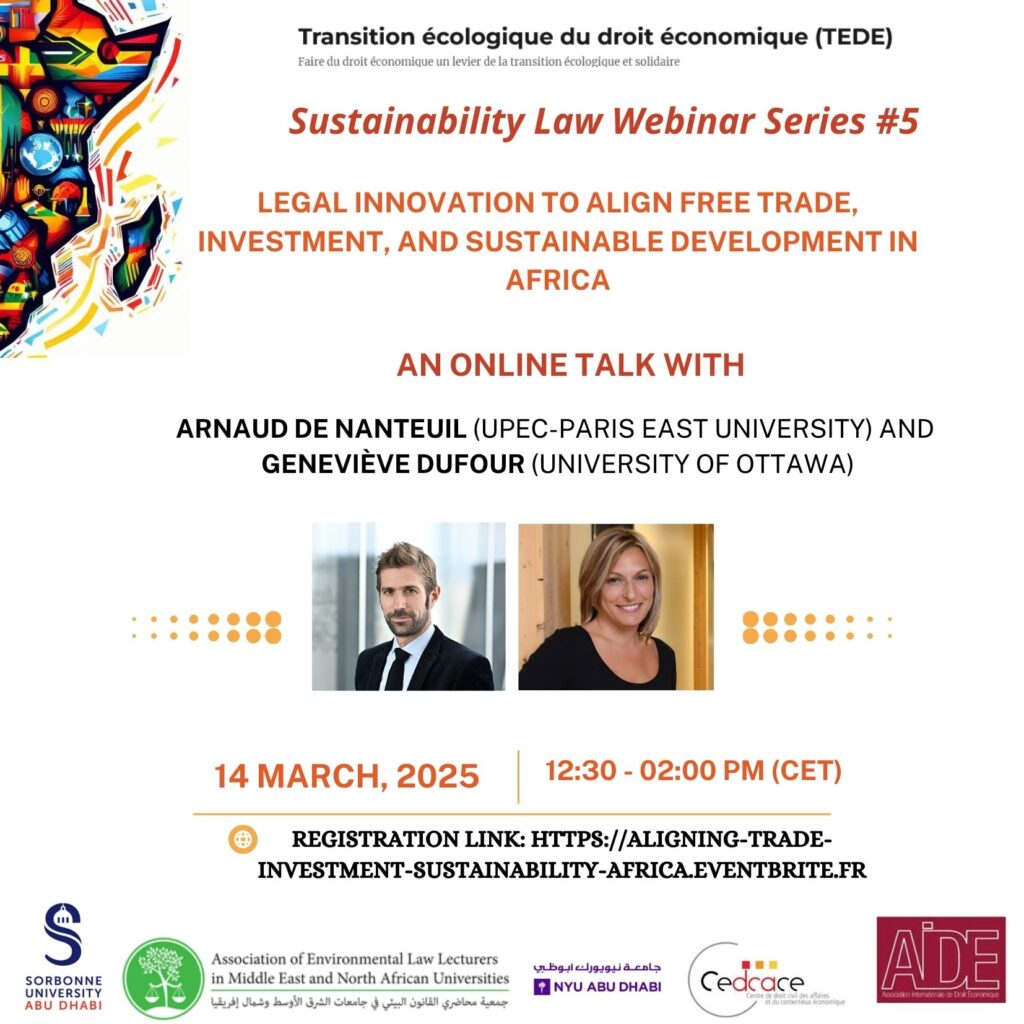
Webinar #5: International Economic Law and the Ecological Transition: Recent Legal Developments in Africa

           Presentation

During the webinar, Arnaud will present his book, *Free Trade and Investment Law in Africa* (Pedone, 2024, in French). This work clarifies the complex interplay between the various legal frameworks governing free trade and investment protection across the continent. It also examines the trajectory these frameworks are shaping, particularly how they incorporate traditional principles of free trade and investment protection while preserving states’ ability to act in the public interest—especially in advancing environmental protection. In doing so, African governments are working toward a new approach to international economic law, one that balances economic interests with broader societal and environmental goals.

During the webinar, Geneviève will highlight how developed countries are increasingly integrating environmental and social requirements into their trade strategies—such as through the EU Carbon Border Adjustment Mechanism, due diligence laws, and deforestation regulations. At the same time, industrial policies like the European Green Deal and the U.S. Inflation Reduction Act are reshaping global trade. While these initiatives pursue legitimate objectives, they also have extraterritorial effects: businesses in developing countries must comply with these standards to access developed markets, often without the necessary resources. This imbalance risks their further marginalization in global trade. Geneviève will explore these trade strategies, their impact on developing countries—particularly in Africa—and potential adaptation measures to foster a more inclusive global trade system.

Arnaud de Nanteuil is a professor of law at UPEC Paris East University and director of the LLM in International Business Litigation. He has authored numerous books and articles on international investment law and public international law. He also serves as an arbitrator, counsel, and expert in international arbitration cases.

Geneviève Dufour is a professor at the Faculty of Law at the University of Ottawa. She holds the Research Chair in Sustainable, Responsible, and Inclusive Trade Law, where she explores the intersections of trade, sustainability, and social responsibility. A leading scholar, legal counsel, and expert in international economic law, she recently co-edited a bookwith Richard Ouellet on the reform of the World Trade Organization (WTO).

Webinar #4: Public Economic Law and the Ecological Transition

Overview

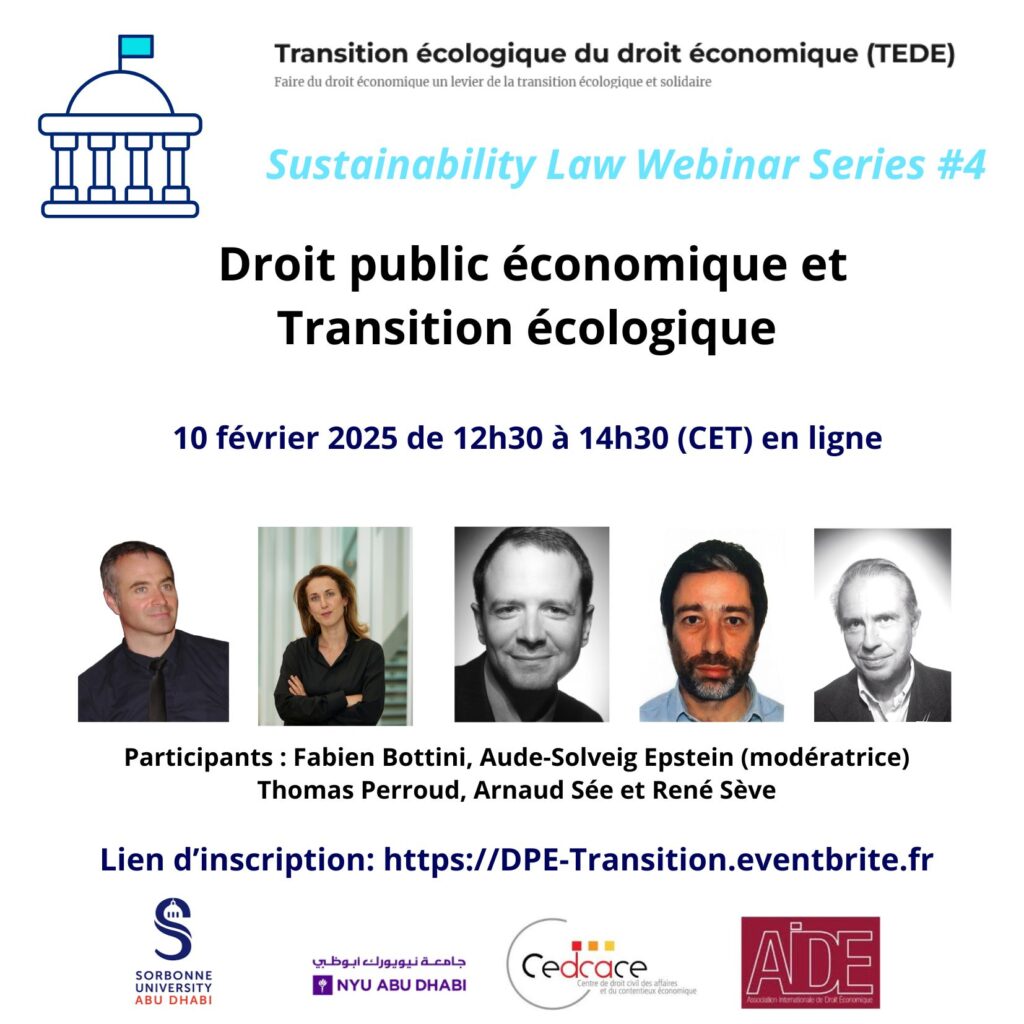
To what extent does economic law is compatible with the green transition? The 4th edition of the Sustainability Law Webinar Series will explore this question from the perspective of public law. Fabien Bottini will present his book on The Eco(lo)nomic Action of Public Authorities (Legitech, 2nd ed., 2024), in which he argues, among other things, for public economic law to embrace the goal of ecological transition. Thomas Perroud, Arnaud Sée, and René Sève will discuss this perspective, in light of their experience in public affairs, comparative public law, public business law, and legal theory.


Fabien Bottini is a professor of public law at the University of Le Mans and holds an Innovation Chair at the Institut Universitaire de France (IUF). Since the health crisis, he has been studying the “ecolomicization” of law—the application of the rules of  law to support the ecological transition in a way that aligns with the goals of sustainable economic development. His research has led him to create and edit the “Dév-éco” section for WEKA Publishing and to found and direct the “Droit & Ecolomie” series for Legitech Publishing.

Thomas Perroud, a professor of public law at Panthéon-Assas University, is a graduate of HEC and Sciences Po Paris and holds a doctorate in public law from Panthéon-Sorbonne University, as well as a PhD from the University of Warwick. He served successively as a lecturer at Paris-Est University and a professor at Aix-Marseille University (Institut Louis Favoreu). He is currently at Panthéon-Assas University (CERSA). He has been a visiting professor at the Universities of Rome 2 and 3, Oxford (St. John’s College), Humboldt (Berlin), and Bocconi. He served as associate director of the Comparative Administrative Law Program at Yale Law School. He was a Humboldt Foundation Fellow until 2024.

Arnaud Sée is a professor of law at the University of Paris Nanterre, where he teaches administrative law, public business and competition law, public procurement law, and energy market law. These subjects constitute his areas of research and practice, which encompass administrative law and litigation. He is also interested in the regulation of digital markets.

A former Research Director at the CNRS, René Sève taught the history of philosophy and legal theory at the École Normale Supérieure and at the Universities of Paris II, Fribourg, Neuchâtel, and Dartmouth. He also headed the office of the Secretary of State for Foreign Trade during the WTO negotiations in Seattle and Doha, as well as the financial oversight departments for public broadcasting and the National Film Center, and the budgetary and accounting oversight departments for the Ministries of Justice, the Interior, and Overseas Territories, in addition to France-Stratégie. He is Director of the Archives of Philosophy of Law (Lefebvre-Dalloz Publishing).

Aude-Solveig Epsteincoordinates and moderates this series of webinars. She is a lecturer in law at Paris Nanterre University and a visiting associate professor at NYU Abu Dhabi. Her research focuses on the intersections between economic law, environmental law, and animal law. She initiated and co-directed the TEDE research project on the ecological transition of economic law, commissioned by the French Agency for Ecological Transition (Ademe) and the Ministry of Justice (IERDJ). In this context, she co-edited the books: Economic Law: A Lever for Ecological Transition? (Bruylant, 2022), Environmental Economic Law: Actors and Methods (Mare & Martin, 2023), and Animal Protection in the EU: The Untapped Potential of Economic Law (forthcoming from Palgrave MacMillan in 2025). She also coordinated the report on The Ecological Transformation of Economic Law, to be published in 2025.

Webinar #3: International Economic Law and the Ecological Transition

Presentation

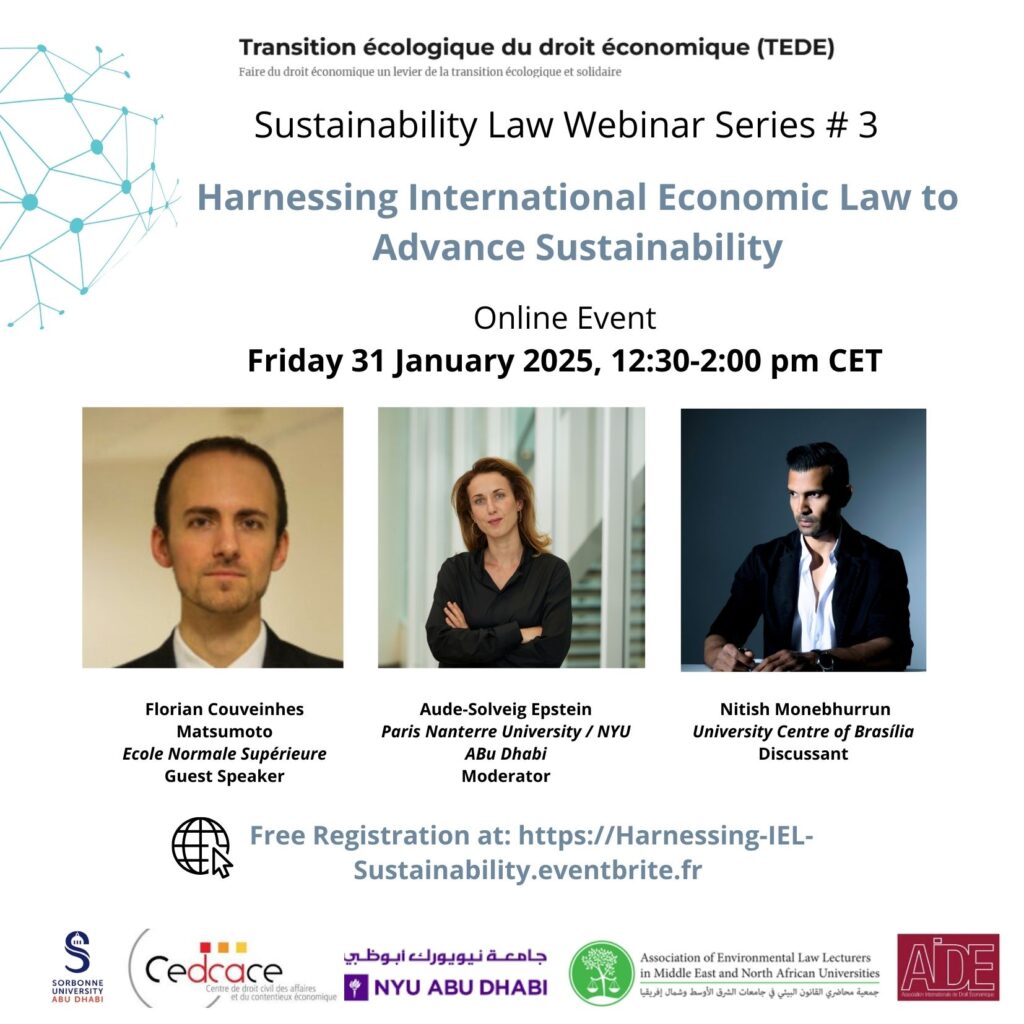
In his recent book International Economic Law (Presses Universitaires de France, 2023), Florian Couveinhes Matsumoto highlights the potential of international trade and investment law to advance sustainability. While certain legal frameworks still disregard sustainability, a new generation of legal instruments is emerging—one that increasingly seeks to balance economic prosperity, social justice, and environmental sustainability. 

Building on this development and its potential to make sustainability achievable, the book also introduces a new approach to international economic law. According to Couveinhes-Matsumoto, international economic law can no longer be viewed as a stand-alone branch of international law focused on promoting global economic growth through free trade and investment protection. Rather, it encompasses all international rules with economic implications, whether their objectives are growth, international or domestic security, respect for human rights, human health, or sustainability. This webinar will explore this paradigm shift and some of its implications for emerging economies.

Discussant: Nitish Monebhurrun is a law professor at the University Center of Brasília (CEUB) in Brazil and a visiting professor at the University of Sabana in Bogotá, Colombia. He is also a consultant and arbitrator in international law (ALAM/CAMESC) and a researcher at the Jean Monnet Center of Excellence on Business and Human Rights (FECAP, São Paulo). Additionally, he directs the Business, Human Rights, and Public Policy Clinic at CEUB and serves as an Editor for the Brazilian Journal of International Law.

Moderator: Aude-Solveig Epstein is an associate professor of law at Paris Nanterre University and a visiting associate professor at NYU Abu Dhabi. Her research focuses on the intersections of environmental law, animal law, and economic law. 

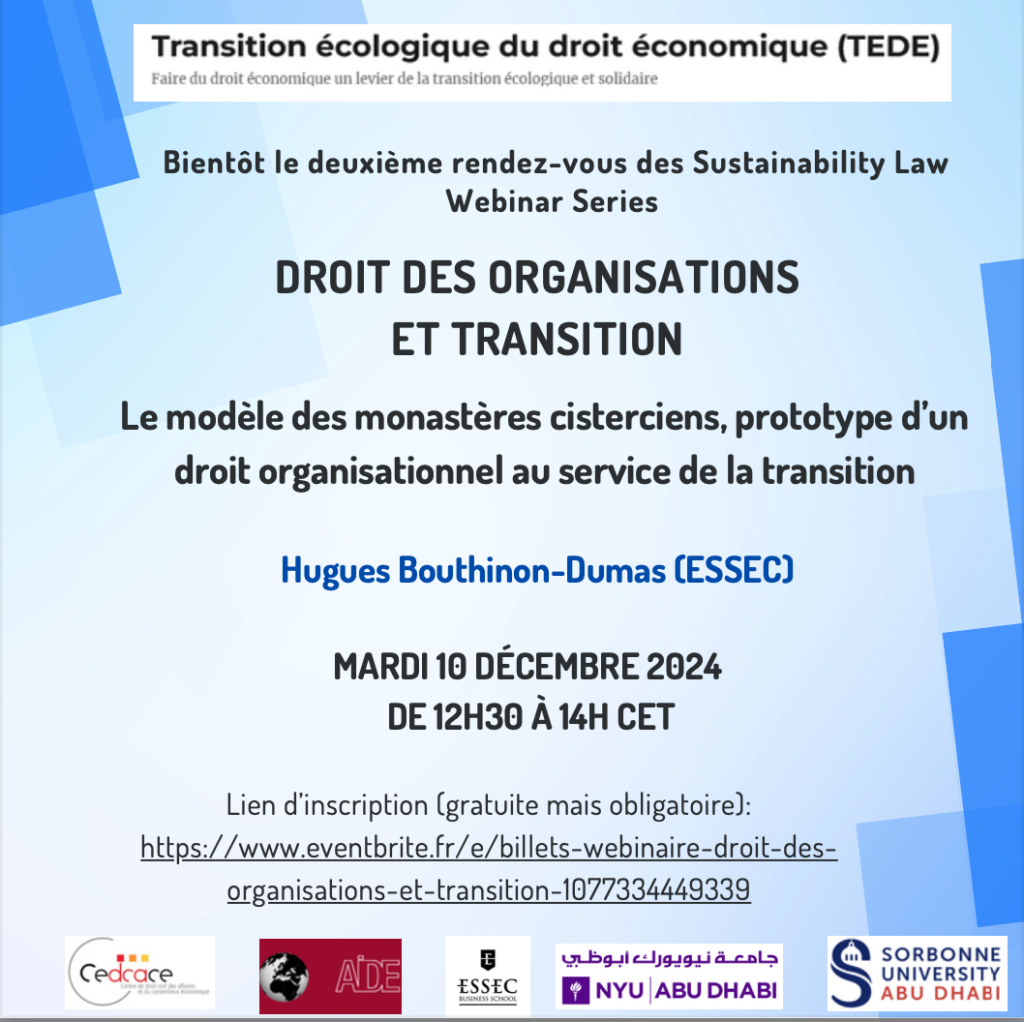
Webinar #2: Organizational Law and Transition

Overview

Hugues Boutinon-Dumas explores the potential contribution of economic law to the transition toward organizational models that are better aligned with the needs of our societies. In particular, he examines the capacity of the law to establish economic organizations that operate in a manner consistent with respect for ecosystemal balances (financing, governance, restructuring, etc.). His search for available models to inspire the reform of contemporary economic law has led him to explore, in particular, the “Cistercian Rule,” that is, the normative framework that governed Cistercian monasteries at the time of their founding in the 12th century. Cistercian monasteries achieved remarkable results not only economically but also ecologically (self-sufficiency, frugality, environmental conservation), socially (fraternal community life), and in terms of governance (pioneering practice of integral participatory democracy). The dense, diverse, and sophisticated regulatory framework that structured these organizations can serve as a source of inspiration today for envisioning organizations that combine exemplary small communities (such as intentional ecological communities) with extraordinary international development.

Speaker's Biography


Hugues Bouthinon-Dumas is a professor at ESSEC Business School, an associate researcher at the CDACI at the University of Montreal, and a temporary judge at the Nanterre Judicial Court. A graduate of the École Normale Supérieure de Paris-Saclay, holder of an agrégation in economic and social sciences, and holder of a doctorate in law (HDR), his research and teaching focus on business law, organizational governance, market regulation, and criminal law. In particular, he advocates for the idea that transition must become the new structuring principle of economic law.

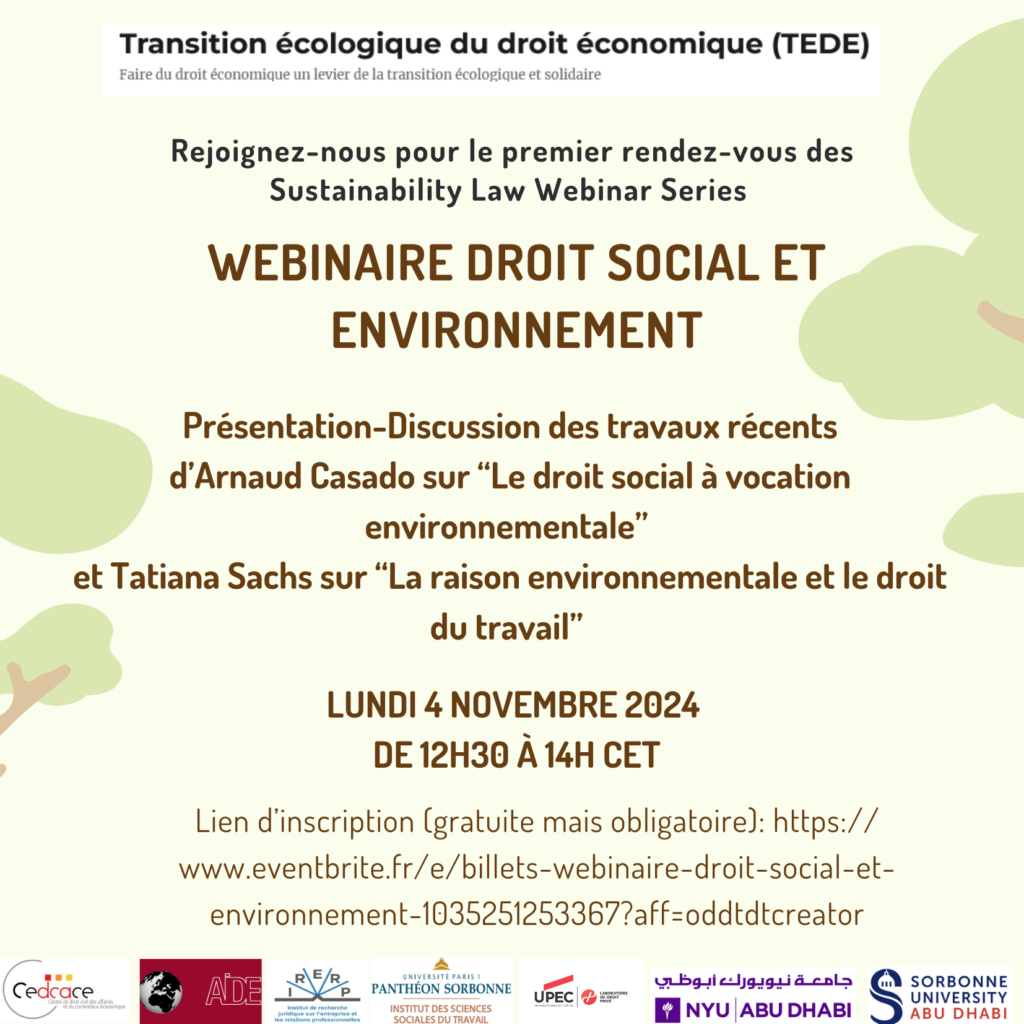
Webinar #1: Labor and Environmental Law

Works on Display


    • A. Casado, Labor Law with an Environmental Focus, LexisNexis, 2024
    • T. Sachs, Environmental Reasoning and Labor Law, Doctoral Dissertation, University of Paris Nanterre, 2023


Abstract


Traditionally focused on the legal framework governing relations between employees and employers, labor law might seem unrelated to environmental issues and outside the scope of the ecological transition. The authors participating in this webinar challenge this perception of the purpose and functions of labor law. Each in their own way, they highlight the ecological role of labor law.


Drawing on an analysis of positive law, Arnaud Casado (University of Paris 1 Panthéon-Sorbonne) highlights the emergence of environmental social law, which offers businesses a new pathway to sustainability through incorporating environmental objectives into social law; standards are no longer invoked solely to regulate relations between actors in the world of work, but also to protect the environment.


As part of her analysis of the environmental dimension of labor law, Tatiana Sachs (University of Paris Nanterre, IRERP) maps out the various ways in which labor law incorporates environmental considerations. The results are mixed: while labor law is receptive to environmental considerations, the transformative power of this integration remains limited for now. It is therefore necessary to identify the conditions under which this integration can be effective.