Le projet de recherche “La Transition écologique du droit économique”, en partenariat avec l’ADEME – Agence de la transition écologique, a décerné un prix récompensant la meilleure contribution produite par un(e) jeune chercheur(se) en matière de droit économique de l’environnement. Le Prix fut remis lors du Colloque des 7 et 8 juin (Le droit économique de l’environnement: acteurs et méthodes) et a récompensé trois jeunes chercheurs.
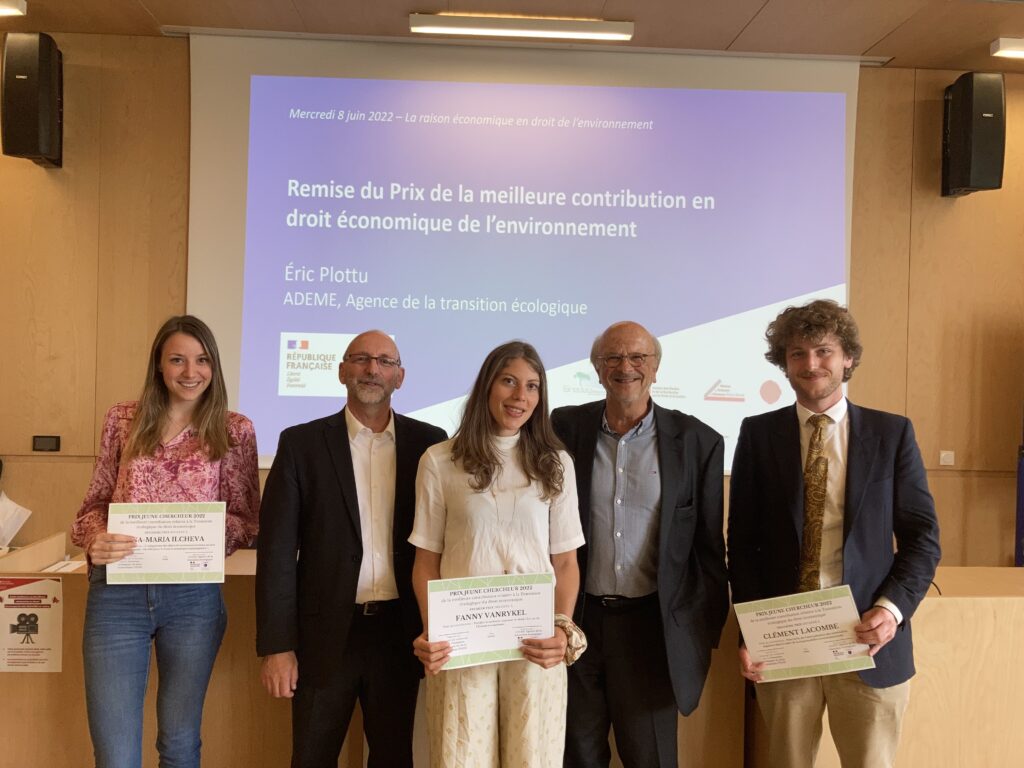
De gauche à droite: Ana Ilcheva (2e Prix), Fanny Vanrykel (1er Prix), Gilles J. Martin (Président du jury), Clément Lacombe (3e Prix)

1e prix pour sa contribution “Tarifier le carbone, repenser le droit ? Le cas de l’Union européenne”
Fanny Vanrykel est doctorante (Aspirante FNRS) à l’Université de Saint Louis-Bruxelles et à l’Université de Liège, Belgique. Dans sa thèse de doctorat, “The illusive simplicity and straightforwardness of a carbon tax: a legal analysis”, Fanny étudie les interactions entre les taxes carbone et leur environnement juridique et les compare avec d’autres stratégies comme le système d’échange de quotas d’émission, en prenant pour cas d’étude le droit européen. Auparavant, Fanny était chercheuse sur un projet multidisciplinaire Belspo-Brain sur l’évaluation des instruments économiques pour une société bas carbone. Elle était aussi assistante en droit public et constitutionnel. Enfin, Fanny a contribué à de nombreuses consultations sur le verdissement de la fiscalité en Belgique, notamment concernant l’introduction d’un mécanisme de tarification carbone.
Sur le colloque : « […] Les réflexions étaient très stimulantes et les angles variés, aussi bien au niveau des disciplines juridiques qu’en dehors du droit […] ».
2e prix: “L’intégration des objectifs environnementaux au sein de l’entreprise : Un défi pour le droit économique contemporain”
Ana-Maria Ilcheva est Docteure en droit et actuellement ATER à l’Université Côte d’Azur. Sa thèse intitulée « L’entreprise à l’épreuve du changement climatique : obligations et responsabilités » étudie les outils juridiques de l’implication de l’entreprise dans la lutte contre le réchauffement climatique et l’évolution de sa responsabilité juridique dans ce contexte. Ana-Maria est membre du GDR ClimaLex et a participé au comité de pilotage du projet de recherche FINCLIMLEX (ISJPS, Université Paris 1– ADEME), sous la direction de Marta Torre-Schaub, portant sur les aspects juridiques et financiers des risques climatiques (2019-2022).
Sur le colloque : « […] c’était une rencontre enrichissante et particulièrement stimulante, à la croisée de plusieurs chemins, qui a su démontrer l’intérêt d’une réflexion sur les rapports entre le droit économique et le droit de l’environnement dans (et pour) la mise en œuvre de la transition écologique. »

3e prix pour sa contribution “Pour la fin de l’internalisation des externalités négatives dans le cadre de la responsabilité environnementale”
Clément Lacombe est doctorant contractuel à l’UMR 6031 TREE (CNRS-Université de Pau et des pays de l’Adour). Il réalise une thèse en droit public et privé, dont le sujet est « Le consommateur d’énergie autonome ». Dans ce cadre il est chargé des travaux dirigés de droit de l’environnement et participé au colloque « L’acceptabilité et le droit public » avec la contribution « RSE et démocratie environnementale, vers un nouveau pacte social ? ». Il est aussi signataire du rapport de la Fabrique écologique « Circuits courts de l’énergie et solidarités énergétiques locales ».
Sur le colloque : « […] j’ai surtout apprécié la qualité des interventions et renouvelé mon appétence pour les appréhensions économiques dans le cadre du droit de l’environnement. Ce colloque m’a aussi rassuré sur la pertinence de ne pas s’inscrire dans la summa divisio juris. Enfin, cela m’a surtout ouvert à d’autres préoccupations, auteurs et objets d’études qui intéresseront ma thèse. »
Le présent règlement détermine : 1/ la nature des travaux éligibles, 2/ les modalités de soumission des contributions, 3/ la composition et les pouvoirs du jury, 4/ le calendrier, 5/ la nature du prix.
Article 1er – Nature des travaux éligibles
Par « contribution », le présent règlement entend toute contribution scientifique de moins de trente mille signes, espaces compris, non encore publiée, portant sur le sujet décrit ci-après.
Les contributions peuvent se présenter sous la forme d’articles académiques, de tribunes, d’éditos ou reportages.
Les contributions sont centrées sur l’articulation, dans le droit économique, entre objectifs environnementaux d’un côté, économiques et/ou sociaux de l’autre. L’inclusion d’une approche prospective est encouragée.
La notion de droit économique doit être entendue dans son acception la plus large, incluant non seulement le droit des affaires, mais aussi le droit du travail et le droit de l’environnement en tant que ces disciplines participent à l’organisation des entreprises et des marchés.
Par « jeune chercheur(se) », le présent règlement entend tout(e) doctorant(e) et docteur(e), âgé de moins de 35 ans le 7 juin 2022.
Article 2 – Modalités de soumission des contributions
Les candidats(es) devront envoyer leur contribution, accompagnée de leur CV, à l’adresse électronique suivante : prix.transition.ecologique@gmail.com
Un(e) candidat(e) ne peut envoyer qu’une seule contribution.
Article 3 – Composition et pouvoirs du jury
Le jury est composé des membres de l’équipe de recherche sur la Transition écologique du droit économique, dont la liste peut être consultée sur le site Internet du projet.
Le jury désigne son président et organise souverainement ses travaux.
Le jury désigne son président et organise souverainement ses travaux.
Article 4 – Calendrier
Date limite de soumission des contributions au jury : vendredi 8 avril 2022.
Résultats communiqués aux candidats : deuxième quinzaine du mois de mai 2022.
Remise du prix : mercredi 8 juin 2022, à Paris, à l’occasion du colloque annuel du projet de recherche sur La Transition écologique du droit économique.
Article 5 – Nature du prix
Le prix consiste en l’attribution d’une somme de 2 000 euros.
Le jury peut décider d’attribuer la totalité du prix à un(e) seul(e) candidat(e), décider d’attribuer un 1e prix ex æquo, d’attribuer un 2e prix, voire un 3e prix ou de ne pas attribuer le prix.
Le, la ou les lauréats pourront se voir proposer de publier leur contribution dans les actes du colloque annuel du projet de recherche sur La Transition écologique du droit économique.