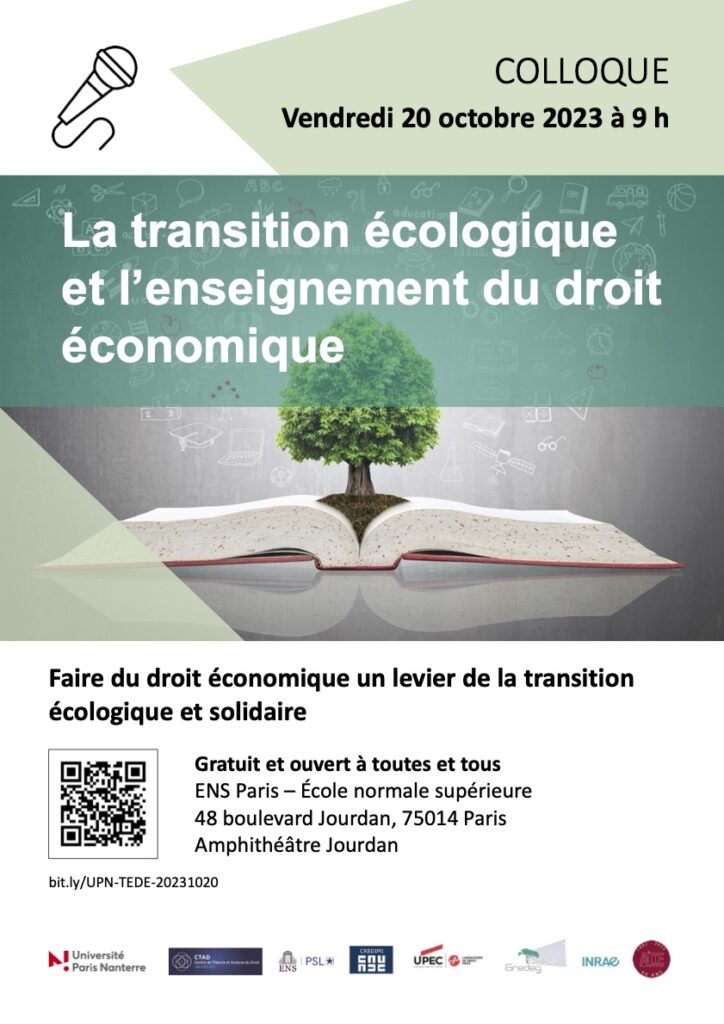
20 octobre 2023
ENS Paris
Amphithéâtre Jourdan
École normale supérieure, 48, Boulevard Jourdan, 75014 Paris
Le colloque pourra être suivi en ligne.
Présentation du colloque :
Il est banal aujourd’hui de voir dans nos modes de production et de consommation, d’investissement et de commerce, bref dans l’économie, la racine des problèmes écologiques. Il est moins courant de s’interroger sur la manière dont les différentes branches du droit économique doivent évoluer pour corriger ou remplacer les pratiques actuelles. Enfin, disons-le : il est marginal de se demander comment nous, enseignant-e-s, devons adapter nos enseignements juridiques, et spécialement nos enseignements de droit économique. Pourtant, comme les plus hautes autorités de l’enseignement supérieur et de la recherche l’ont reconnu dans l’Accord de Grenoble des 10 et 11 avril 2021, s’engager dans une telle réflexion est à la fois essentiel et urgent.
Comment procéder ? D’abord en dressant un état des lieux et en recherchant les questions soulevées par la confrontation des pratiques actuelles d’enseignement et les exigences écologiques. Pour ce faire, une table-ronde introductive rendra compte des résultats d’une enquête sociologique auprès des enseignants de droit économique sur leurs pratiques d’enseignement, et d’une étude des manuels de droit économique. Ces résultats seront ensuite débattus et comparés à d’autres pratiques d’enseignement, y compris à l’étranger. L’interrogation majeure sera notamment de savoir si la transition écologique réactive simplement de vieux débats quant à l’enseignement du droit économique ou si elle pose de nouvelles questions.
Dans une deuxième table-ronde, nous proposons de rechercher à quel point la cohérence de différentes branches du droit économique est mise en question par l’évolution des textes. Les questions sont nombreuses. La dimension transversale et globale de la transition écologique est-elle parvenue (ou est-elle en train de parvenir) à modifier/enrichir l’enseignement du droit économique ? Le renouvellement de l’enseignement du droit économique est-il le résultat mécanique de l’évolution législative (inégale) dans les différents champs disciplinaires ou d’une approche plus substantielle d’ouverture à la transversalité des enjeux ? La transition écologique peut-elle devenir une source de décloisonnement de l’enseignement du droit économique et du droit de l’environnement ?
Un tel questionnement sur les rapports entre droit économique et écologie conduit à s’interroger sur la délimitation des disciplines juridiques, sur la possibilité d’user dans un domaine de techniques existant dans d’autres branches du droit, sur l’enseignement des rapports entre les branches du droit ou sur l’articulation de l’enseignement avec les concours auxquels préparent les études de droit économique, bref sur les méthodes de l’enseignement, notamment au regard de la recherche en droit économique. Nous aborderons ces questions théoriques et méthodologiques dans une troisième table-ronde, où seront également examinés les avantages et caractéristiques de l’enseignement clinique du droit.
Prolongeant cette réflexion sur l’enseignement du droit économique, la quatrième et dernière table-ronde l’abordera quant à elle sous un angle résolument pragmatique. Elle sera en effet consacrée aux efforts institutionnels de « verdissement » des formations et à des retours d’expériences sur l’enseignement du droit économique, dans un contexte où les enjeux sont de plus en plus indissociablement économiques, écologiques et sociaux.
Au terme de cette journée mêlant panorama des pratiques actuelles d’enseignement du droit économique, réflexion sur le rôle que les universitaires peuvent jouer dans leur renouvellement, et enquête sur les projets et techniques les plus stimulants, nous espérons que les enseignant-e-s, étudiant-e-s et curieux auront gagné en réflexivité et en envie d’innover dans le cadre de l’immense processus en cours, d’adaptation du droit économique aux enjeux écologiques.
ACCÈS : campus Jourdan de l’ENS au 48 Bd. Jourdan, 75014 Paris, RER Cité internationale, Métro Porte d’Orléans, arrêt Montsouris du Tram T3a, arrêt Jourdan – Montsouris du bus 88
Pour suivre le colloque et y participer à distance : https://meet.goto.com/622519613